Saturday, March 1, 2014

Paco de Andalucía

On the first day of guitar class junior year of high school, Mr. Anastasio asked us all to introduce ourselves and say why we wanted to learn to play the guitar. The class was full of eager boys with dreams of making girls fall in love with them by screaming onstage with electric blue guitars. The boy I had had a serious crush on in middle school was in this class and fell into this category. When it was my turn, I announced as I cradled my mother's beautiful inlaid Spanish guitar that I was learning guitar because I wanted to play flamenco. Mr. Anastasio raised his eyebrows and told me that flamenco was absolutely the hardest style I could learn to play.

That was the beginning of my education on flamenco. I had thought that flamenco was the soundtrack to the Zorro movies. From Mr. Anastasio I learned what real flamenco was: the sounds of Paco de Lucía, often considered the best flamenco guitarist.

Paco de Lucía’s death on Wednesday has significance for anyone who has been touched by flamenco and flamenco fusions. For me, it meant the death of the first and perhaps most important flamenco name I knew. The allure of flamenco tremolos and swirling red skirts is a large part of why I am currently living in Sevilla—and more specifically, Triana, the birthplace of many flamenco songs. Flamenco today is what it is largely because of Paco de Lucía’s revolutionary musical creativity that blended flamenco with other styles without leaving behind the flamenco essence. His death has brought into sharp focus the fact that the twenty-first century experience of flamenco, which to me often feels so electrically intimate, has been marked by the genius of an artist whose legacy overruns borders from Algeciras to New York.

Yesterday in Alcalá de Guadaira as I approached the city’s castle with its Islamic foundations that date from the twelfth century if not earlier, I heard the unmistakable sound of a cajón and palmas marking rhythms. It was the Day of Andalucía and the town, not far from Sevilla, was sparsely dotted with clusters of families enjoying meals in the sun and high school students getting up to no good on their day off from school. A group of adults, teenagers, and children were eating, drinking, and making music beside the castle. Paco de Lucía’s influence was present in this ancient space just above the uber-modern dragon-shaped bridge in the valley: his musical group introduced the cajón, a square Peruvian instrument, to the flamenco scene in the 1980s (NYT). Here, on this sunny day in Andalucía, it was being used to accompany the handclaps and folk singing. The music was perhaps not precisely flamenco in the purest sense, but the rhythms and minor sequences, sung in voices that always sounded a little bit pained, channeled the same deep Andalusian heritage. With the cajón and the dragon and the castle the scene was Andalucía globalized—but Andalucía nonetheless.

Music by the castle walls in Alcalá de Guadaira
Andalucía is not a land of purity. Islamic, Christian, and Jewish traditions and structures combine. Flamenco combines with rumbas and tangos, and flamenco itself combines many elements of the diverse gypsy-Moorish-Andalusian experience. One form of expression that typifies this tendency to combine cultures and art forms is the song and dance called Sevillanas. Although dancers wear flamenco outfits and shoes, and the dance itself is complete with flourishes of the arms that very closely resemble flamenco movements, it is not technically flamenco. It has four set parts that are always danced the same way, so that in parties and social gatherings people can dance it in partners. It is a folk tradition of Sevilla that has incorporated many flamenco elements, and it is largely the dance of choice at Sevilla’s annual Feria, a big to-do in a huge field with dancing and celebrations that falls in May this year.

I got to practice the sevillanas I have been learning at a bar with flamenco on Thursday night. So far I have only learned the first part; I look forward to dancing all four parts in full regalia for Feria. After the sevillanas and a few rumbas, the two guitarists in the bar played Entre dos aguas in homage to Paco de Lucía. 


Flamenco and fusion will go on. In the Plaza del Altozano and the Plaza de Santa Ana in Triana, women and men will keep singing and dancing and playing guitar and clapping their hands. But what will it take for someone to reach the level of technical mastery and inventiveness of Paco de Lucía? I trust the land of Andalucía and its capacity to meld art forms into something new and at the same time very, very old. It is a land of venerated old poets and energetic young ones. Perhaps today there is a little girl near the Guadalquivir somewhere, learning her very first guitar chords, who is as familiar with the wooden curves of the instrument as she is with the sleek silver silhouette of an iPhone—and perhaps she will revolutionize this world of globalized flamenco.

Sunday, January 26, 2014

The River


Right behind my backyard is the playground of what used to be my elementary school, and just beyond that is the creek. Of course we were never allowed near it during recess. But after school or on weekends I would sometimes go there with my neighborhood friend and we would try to make it across on the natural stepping-stones without getting wet, all while incorporating everything we did into the larger story of our Let’s Pretend game. The grown-ups could cross the creek on a small green wooden-plank bridge that led to the other neighborhood. Technically I think we are supposed to be all the same neighborhood, but the creek decidedly divides us.

When I went away to Harvard, I lived on the other side of the Charles. Cambridge faces Boston but is removed from it. From the eighth floor of Leverett F-tower in the evening you can watch myriad pairs of headlights move along the highways and crisscross the city that is lit up in all its urban beauty. You can watch Boston live, but you don’t live there. If you are munching on goodies at the Resident Dean’s study break on the eighth floor of F-tower, you live in Cambridge. More specifically, you live in Harvard Square. Normally, you think, Why go into Boston, when on this side of the river I can eat sinful chocolate-raspberry cake at Finale and slurp raw oysters at First Printer? When Zachary Quinto is acting in The Glass Menagerie at the American Repertory Theater and Salman Rushdie is signing books at the First Parish Church? And then you go into Boston and you think, Why don’t I come here more often and sit and read in Boston Common? Or eat sesame chicken in Chinatown or lobster ravioli in the North End?

The Charles

Even when I studied abroad in Granada, I lived on the other side of the river. The Genil is a sad, mostly dry little rivulet that divides the main part of the city from a suburban area. But I still sat by it many a time and thought about Carlos Fuentes and life and boys as I looked into its glassy surface. The outer area of the city beyond it wasn’t particularly pretty—although you could still glimpse some of the little white houses up on the mountain with their orange lanterns—but there was more space here. The host family I lived with had a garden with a dog and a pool. It was a thirty-minute walk to the center of town, but it felt worth it to live in this house with this family.

Now I am living on the other side of the river again. Just across the Guadalquivir from Sevilla proper is the old, picturesque neighborhood of Triana. My neighborhood.

Technically Triana is part of Sevilla. But as Antonio, a doorman at the office where I write, has told me, “Mira si soy Trianero—que cuando cruzo el puente, me siento extranjero.” (“See if I’m not from Triana—when I cross the bridge, I feel like a foreigner.”) The river seems so benign now, the breeze ruffling its surface so it’s hard to tell which way it’s flowing. But before its tributaries were re-routed, it used to flood Triana every other year with its angry swells. And even today, as it flows ever so calmly, it marks an inescapable divide--it is not innocent.

The esplanade by the Guadalquivir

The divide is more evident than ever on weekends. While on the Triana side old men wear hats and take small steps with their grandchildren as they walk up and down the length of the Calle Betis, across the way on Paseo Colón cars roar by in four lanes and young people drink beer and mixed drinks as dance music blares from the kiosks where they ordered them. While on Calle Betis people dance flamenco without costumes, across the way on the promenade down by the river people go jogging and young couples hug one another to each other with their legs dangling over the water. 

The crowded esplanade today

Perhaps I am drawn to the “other side” of the river out of familiarity. Perhaps I like it because there are always gems on the other side that you can’t find in the main part of a city, and not so many people fighting over them. Perhaps I like it just because then I get to look out over the wide river at the loud streets, the touristic landmarks, and the people—but I don’t always have to be there. The river gives me breathing space, and inspiration, and calm. And when I cross it—in either direction—I cross into another world.

Flamenco on the steps to Calle Betis, with Sevilla proper in the background across the way

Tuesday, November 26, 2013

Sevillas


On a narrow cobbled street near the river, my friend and I followed the muffled sound of socialization and at last found what we were looking for: La Casa de Max. We pushed open a big black door and found ourselves in a dimly let space that must have once been a garage or basement, and had been converted into a venue. A skull on the wall made me feel vaguely like I was in Little Five Points in Atlanta. Elongated wrought iron stick figures that seemed to dance and stretch supported a rounded raised stage.

At length from behind a gate that could have belonged in a haunted house came three masked men. They called themselves Los Poetas Pluscuamperfectos (The Pluperfect Poets). Two wore Mexican lucha libre masks, and one wore a black sack cloth over his face. Already in character, they began their performance—a mixture of theater and poetry reading that formed an extended and ironic ode to “el odio” (hatred). Max, whose house it was, puffed calmly on a cigarette in the shadowy background as he managed the remixed salon music from the twenties that played softly throughout.

Here I was, in el casco antiguo—the old part of town—enjoying a show that had nothing to do with the flamenco shows put on for guiris (foreigners), the baroque churches, the processions of virgins—in short, it had nothing to do with what one might expect to find in the old part of a storied Andalusian city like Sevilla. And yet, this experimental performance and funky venue, I have learned, are examples of something that is far from simplyan “alternative” to this other Sevilla that we think of. They are part of one of the many Sevillas present in this city that continues to surprise me. These Sevillas are not exclusive or independent of one another; they are different threads in the larger fabric of the city. Some of these threads, like the warp on a loom, are somewhat hidden away, while others, like the weft, are more obvious. But they nonetheless work together (thought not always harmoniously) to sustain the city’s vibrancy.

I recognized the poet with the Mexican accent behind his lucha libre mask. I can’t tell you who it was because the Pluscuamperfectos are supposed to be anonymous. But let’s just say that Iván Vergara, who had told me about this event, only appeared after the performance was over and the poets had left the stage. Iván, the energetic leader of the Plataforma Chilango Andaluz here in Sevilla, had invited me to read that Thursday at his venue, Ultramarinos, for the eighth annual installment of the Recital Chilango Andaluz, a dynamic poetry event that takes place in Mexico City and Sevilla.* After experiencing the spectacle in La Casa de Max, I wasn’t sure what to expect that Thursday, October 31st.

I arrived at Ultramarinos on Halloween huffing and puffing, certain I was late. It was fifteen minutes after the time I was supposed to be there to prepare for the performance. But no—I was among the first ones there, including the other poets who were supposed to read. Ultramarinos is accessed through a big black door much like the entrance to La Casa de Max, except that the door opens to a large corral, an old enclosure with a complex of houses. Not many of these still exist in the city. Ultramarinos is one of the houses in the corral—a venue with a cheap bar and books everywhere: old copies of classics interspersed with beautiful handmade cardboard books from Editorial Ultramarina. A few lucha libre masks hung from one wall.

All the poems read were accompanied by video, sound, images, or some combination of these. The poets ranged from nineteen or twenty to middle aged, and included both women and men. I closed the show with a few pieces accompanied by Mexican mariachi music and Spanish fandangos. Squinting in the darkness and addressing this cozy place was a far different experience from performing poetry in Lowell Lecture Hall at Harvard’s Presencia Latina. It was as if it was all a bit of a secret.
My poetry reading at Ultramarinos

At a nearby bar called Un Perro Andaluz,** things were bigger and louder. A reddish hue tinted everything, including the old books, the white piano, and the writing on the walls. Two poets named Adriana read their poems to a crowd that drank and clapped and listened and laughed in the light of a lamp that was shaped like a woman but had a shade for a head. It was the first of a revival of the series Las Noches del Cangrejo, a once-monthly event put together by Cangrejo Pistolero Ediciones and spearheaded by the Cangrejo Pistolero himself, the poet and editor Antonio García Villarán.

On the second of the revived Noches del Cangrejo, the Perro welcomed a pair of artists nicknamed Yellow and Vicio. They combined theater, music, and poetry in a series of performances that had us all laughing. Perhaps the Sevilla of the Noches del Cangrejo is not the Sevilla of the Poets of the Generation of 1927, who sought to both revive the elusive poetry of the Baroque poet Luis de Góngora and to break with modernismo. Or perhaps, in a way, it still is. Perhaps this is the twenty-first century, crisis-driven response to more traditional poetry readings. Perhaps Perfopoesía—performance poetry—is a re-enactment the theatrics of the surrealist movement, but in a new, updated way that serves the needs of Sevilla and the Sevillanos of 2013.


Antonio García Villarán and Nuria Mezquita present La Noche del Cangrejo in El Perro Andaluz

I’ve found other Sevillas, too. In Especie de Espacios, a bookstore right around the corner from a dance school that serenades the street with flamenco stomps, poets, novelists, and photographers comingle and peruse books by Sevilla natives that share shelves with the Chilean Raúl Zurita’s Zurita and translations of Philip Roth novels. A section of the Mercado de Triana where I buy fresh groceries has recently been converted into a theater. Money may be lacking for Sevillanos—but not creativity, and an urge to re-invent and invigorate a city that is much more than the Catholic, traditional Sevilla that the tourists see.

And yet the traditional Sevillas do exist. Just this past Sunday I hurried outside to watch the procession I knew must be happening because of the loud, measured drumbeats I heard, as well as the throngs of well-dressed people passing by my window—including small children in their best camel, cherry red, and pastel blue outfits who chased each other and laughed beneath my balcony before their parents hurried them on. A huge float with a baby Jesus rising from an ornate complex of roses approached the entrance of a church. A large crowd of young and old was gathered to watch. A toddler kept repeating to his father who was about to duck back under the float to help carry it, “Que te vaya bien, Papi! Que te vaya bien!” “I hope it goes well for you, Daddy!”

A photo of a similar procession of a virgin in Triana. The virgins in Bar Garlochi resemble this.

How are we to make sense of this mixture of old and new, this perpetuation and rupture of tradition all at once? One bar in the Alfalfa neighborhood in the center of town offers a postmodern approach to addressing this question. A crying virgin with a triangular golden robe that could easily be atop a traditional processional float greets visitors at the entrance of Bar Garlochi. Enter and the red and gold baroque niches and figures are too much to take in in one night. In place of a virgin in one window-niche is the latest heiress of the fortune of the Duchess of Alba. Here you can enjoy the house cocktail Sangre de Cristo (Blood of Christ) and you might run into a novelist who is drinking to help him decide what to tell his agent who wants to change the title of his book. Behind the bar, the big-bellied owner serves drinks, keeps tabs, and surveys his blasphemous church and its clientele contentedly.

The city I am getting to know is a multifaceted mixture of the sacred and the profane. In this post I have attempted to provide a few snapshots of the Sevillas I have encountered. There are still many, many Sevillas of whose existence I am not even aware—and a year here is not enough time to discover them all.


*Chilango is slang for someone from Mexico City, and Andaluz refers to being from the Spanish region of Andalucía.
**A reference to Salvador Dalí and Luis Buñuel’s film Un Chien Andalou

Sunday, October 27, 2013

Strings


A NOISELESS, patient spider,

I mark’d, where, on a little promontory, it stood, isolated;

Mark’d how, to explore the vacant, vast surrounding,

It launch’d forth filament, filament, filament, out of itself;

Ever unreeling them—ever tirelessly speeding them.
  

And you, O my Soul, where you stand,

Surrounded, surrounded, in measureless oceans of space,

Ceaselessly musing, venturing, throwing,—seeking the spheres, to connect them;

Till the bridge you will need, be form’d—till the ductile anchor hold;

Till the gossamer thread you fling, catch somewhere, O my Soul.


We all know the image: the half-crazed violinist who in his empassioned frenzy pops a string and yet continues playing till the end, the grandest of grand finales, his toupee bouncing from side to side. What makes him go so crazy? What makes him give of himself entirely to the music, to the sounds he is producing, forgetting the world in order to do so?
           
I have played music, but I would not call myself a musician. When I watch truly amazing musicians, I marvel at their performance not just because the melodies and harmonies they produce are so beautiful, but because I have played just enough to know how much effort, time, practice, and dedication must go into such a performance. And, even though I will never play at the level of the greats, I nonetheless feel a certain kinship. Because I understand the dedication to an art form, an act of creation and performance, that borders on ludicrous obsession but is nonetheless essential to one’s existence.

Certainly each and every violinist has his or her own particular reasons for perspiring and working himself or herself into a frenzy while performing. The caricature I have drawn does not do justice to the diversity of violinists. But all would share, I believe, an intense commitment to their art that goes beyond the mundane and enters a realm that could be called spiritual—a realm that encompasses what Walt Whitman might call the “Soul.”

Strings tie things together. They are tendons, ligaments, filaments. String theory posits that on the quantum level, matter is not a set of self-contained points but rather a set of tiny strings, each one vibrating at its particular frequency, to voice its part in the grand symphony that is the universe. If this is the case, it is no wonder that we feel a bond with those around us when we join together to sing hymns in a temple of worship, or our fight song at a football game. There is something electric, primordial, and bonding about listening to and participating in live music. When string instruments produce the music, it is not only their strings that vibrate, but also the air, the atmosphere, and something deep within us.

Orquesta Àrab de Barcelona

Recently I have experienced this communion through music. Under the moonlight and against the backdrop of arabesque architecture, the Orquesta Àrab de Barcelona gave the pleasant Sevilla night its fusion of Eastern and Western sounds that at once entranced with its exoticism and contented with its familiarity. Mohamed Soulimane focused our attention quickly with peppy notes he played on his electric violin.* Sergio Ramos (“el mejor Sergio Ramos en toda España!” Soulimane proclaimed) got us moving with his rock percussion. Mohammed Bout assumed a very proper, upright stance and moved his hands delicately as he sang in Arabic.

The concert was sponsored by the Fundación Tres Culturas del Mediterráneo, which seeks to bring together the Catholic, Jewish, and Arabic cultures of the Mediterranean. In Sevilla these three cultures have historically been very present. Even though today there is a church on every other corner and a different virgin processes through the streets almost weekly, the tall Cathedral tower that everyone uses to get their bearings, the Giralda, is a relic of the old mosque that has been subsumed into the Catholic architecture; the river that is the lifeline of the city, the Guadalquivir, derives its name from the Arabic for “Río Grande” (“Big River”); and the old “judería” or Jewish neighborhood, is now part of the labyrinthine tourist trap called Barrio Santa Cruz. On the one hand, Catholicism and its traditions are sacred in Sevilla, and on the other, so much of the city’s distinct flavor stems from cultures that are held to be exogenous and foreign (as if Catholicism were not exogenous). That the Orquesta Àrab de Barcelona delighted a packed audience with its fusion of music and cultures illustrates that at least in some circles, Sevillanos are eager to embrace the multicultural presence in their city.**

Catalan, Spanish, and Arabic comingled that night, as did ancient and contemporary sounds, young people and the elderly. At the end we all sang along to a song that went “Allah, ho, Allah!” (“You don’t have to say Allah if you don’t want to, but you won’t get a rash if you do!” Mohamed Soulimane told us) and afterwards we asked for more. The dancing began; Soulimane called a young woman and a pregnant woman up to the stage and they happily showed off their Moroccan-flamenco fusion moves. With music and dance combining, the electric strings and vocal chords that had been vibrating and searching all evening struck their mark, and for at least a time, we were all in this together.


Guitars among the Ruins and the Glass

Two weeks ago was the Guitar Festival in Sevilla. On Wednesday I accompanied a friend who studies guitar at the conservatory here and saw Lorenzo Micheli and Javier Riba perform some of the most beautiful classical guitar music I have ever heard. Before the yellow-lit Roman ruins of the city housed in the Antiquarium of the Plaza Mayor, in a glassed-in concert hall that reflected light from everywhere, they elevated the guitar to a place it does not always occupy. I do not always think of the guitar as a classical instrument, but rather as a versatile, portable instrument that almost anyone can learn to strum. As an instrument, it is not often taken seriously. A cheap guitar is affordable, and you can play a song knowing only three chords. The guitar is often the instrument of the poor and of the undedicated men who want to pick up girls. Even when played well, the guitar does not always coexist alongside the elegant violin or the austere cello. But this concert reminded me that the guitar should be taken more seriously. Micheli and Riba treated their guitars as if they were Stradivarius violins,*** and the sounds they coaxed from them were, in my opinion, more lovely than what could be coaxed from a violin. There is just something that gets me about the guitar, more than any other string instrument. And to hear it played in Sevilla, where the guitar is an essential element of the city’s identity, was to feel a humming connection to the city’s core.

Gray Beards and Fresh Faces

In the last concert of the festival on Saturday, a cohort of men in their forties and upwards introduced the four top finalists of the weeklong competition. The finalists were young men in their early twenties at the most, who played in ways that stunned me as much as their teachers had on Wednesday, if not more so because of their young age. After the intermission, students from the esteemed Fundación Cristina Heeren, a flamenco school, performed flamenco guitar pieces with palmas (hand claps). The concert, held in a traditional music hall, was in many senses a bastion of form and convention. It was beautiful and moving, and I felt privileged to mingle with such great artists afterwards at the wine-and-cheese gathering.


But art does not stay within an institution. And Sevilla’s art is found all over, not just in concert halls that charge entrance fees. At 2am that night on a side street off the Alameda, one of the most hopping bar neighborhoods, the classically-trained musicians I was with stopped and listened to the impromptu flamenco jam session that had been struck up. Humble young people with piercings and tattoos strummed bulerías, alegrías, and tientos, sang with their faces contorting, and clapped out palmas. There, amongst the cobbled shadows, was another face of Sevilla. Another set of artists, friends, seeking to express themselves, to unite their souls for a time, to launch strings out into the world and hope they catch somewhere.

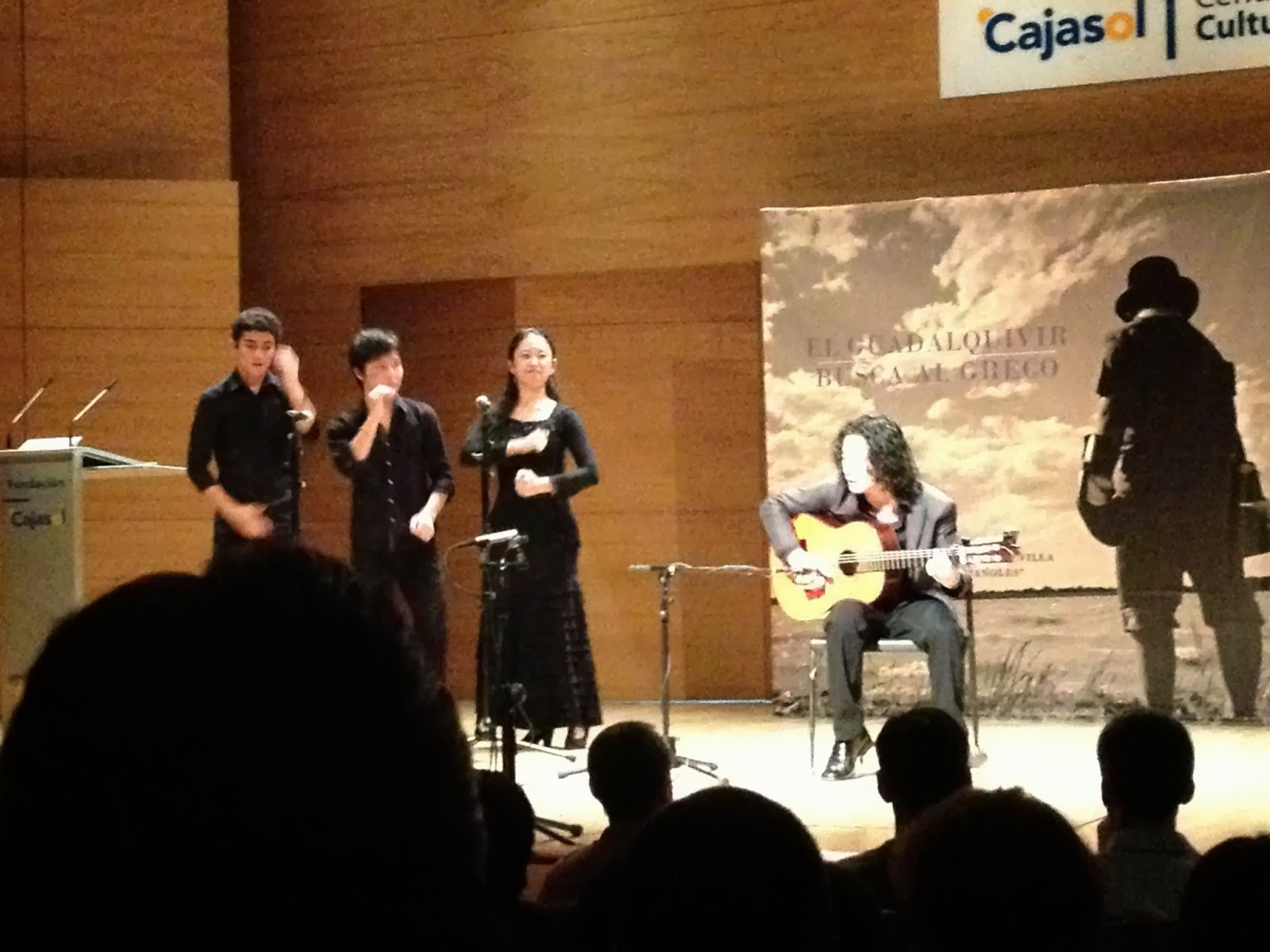
This is what I’m searching for, maybe what everyone is searching for: connections. String vibrations, literally and metaphorically, are at once distinctly individual and intensely communal. If a tree falls in a forest and no one is around to hear it, it has made vibrations, but technically no sound. For that, an ear is needed. Vibrations need ears to make connections. Especially in this year, I am searching for human connections, connections across time and space. Connections between 1500s Sevilla and 21st-century Sevilla. Between the Cajasol concert hall and the flamenco singers on the streets of the Alameda. Between America, Asia, Africa, and Europe. I am seeking to find them, to forge them, to understand them. I do this by writing. I write to find my own particular rhythm of vibration at which to hum in order to play my part in the harmonious symphony of the universe.


*Perhaps this music is tailored to Orientalist-trained Western tastes; nonetheless, I found it beautiful.

**The concert took place at the Fundación Tres Culturas in the Cartuja, the large site of the 1992 “Exposición Universal” that commemorated the 500th anniversary of Columbus’s “discovery” of the Americas. The foundation is on Calle Max Planck, just off the Avenida de los Descubrimientos (Avenue of Discoveries). The Cartuja is a rather ugly, industrial area that nonetheless created space for cultural activities and provides a testament to the city’s 1992 embrace of many different cultures. The Expo brought with it a massive transformation and beautification of the city, including the creation of a riverfront walkway and the proliferation of “zonas peatonales” (“pedestrian zones”).

***Riba’s guitar was indeed 113 years old and had been played by a famous guitarist way back when.


Tuesday, October 15, 2013

Los Toros: A Performance

A las cinco de la tarde.
Eran las cinco en punto de la tarde.
Un niño trajo la blanca sábana
a las cinco de la tarde.
Una espuerta de cal ya prevenida
a las cinco de la tarde.
Lo demás era muerte y sólo muerte
a las cinco de la tarde.

It was just five in the afternoon.
A boy brought the white sheet
at five in the afternoon.
A basket of lime made ready
at five in the afternoon.
The rest was death and only death
at five in the afternoon.

--Federico García Lorca, fragment from "Lament for Ignacio Sánchez Mejías." Translation by A. S. Kline.


The torero, or bullfighter, is supposed to be a sexy creature. From the moment he enters the Plaza de Toros with his cape the color of fresh blood, he is the ancient symbol of the virile Spanish man. His exceptionally gaudy and colorful outfit—complete with pink socks, plenty of sparkly gold bling, and the funniest of little black hats—fits him very, very tightly as he steps out in perfect posture. I don't care who you are, you can't miss the marked curve of his little butt that he sticks out proudly as he strikes his performer's pose. Despite the ridiculousness of his outfit, his presence is commanding, and the crowd responds to it as such.

I had barely been in Sevilla a week when I watched the events of the Saturday Feria de San Miguel celebrations unfold under the afternoon sun between an Australian couple and a couple from Madrid who had traveled to Sevilla expressly to see los toros, the bulls. Around us sat a mixture of Spaniards and foreign tourists, often American or French. A bullfight is one of the must-see spectacles in this city—if you can stomach the sight of a peculiar form of animal violence. Regardless of one's particular position on bullfighting, the experience is an interactive art form imbued with tradition that offers a window into Sevillian culture, and a living history of sorts.

There were three toreros and six bulls. When a banderillero pricked the first bull, the Australian woman beside me said, "So that's it, right?" I shook my head. "Not nearly about," I said.  

A banderillero avoids horns just after sticking the banderillas in the bull's neck


I had seen a few corridas, or bullfights, on television, but seeing it live for the first time was a completely different experience. The electric charge of the silence as the men on the torero's team of helpers in the sandy ring concentrated; the hulking, muscular black form of the bull; the call and response of male human voices and charging animal hooves—all these kept me on the edge of my seat like a World Cup game between Mexico and Argentina. Because when I watched the blood darken to purple against the animal's hide and when I heard it grunt before charging the man who was always no longer there, the bull forced me to face the raw fact of death in its immediacy, not as an abstract concept I prefer to conceive of as far removed into the future.

The bulls were "muy flojos," the Madrileña woman to my left informed me. They lacked energy. The second torero instructed his men to weaken the bull too much, draining too much blood from it, with the result that the animal was buckling at the knees before the torero even had time to demonstrate his skill with the cape. It is no wonder that one of my friends had to leave early. For him, as he put it, the spectacle became "no longer a game of death, but a game of suffering."

In its purest form, bullfighting is supposed to be a game of life and death. If the torero has a good faena, the Madrileña woman told me, it means that he has proved himself against the bull; he has dominated him. He has danced with the bull, he has subjected him to his will. He has dominated the animal without emasculating him. He has faced an animal with a pair of fearsome, phallic horns, and finished unequivocally—even beautifully—victorious. If he does everything just right, he wins the bull’s ear.

In an attempt to not be the ugly American and instead fit in, I clapped when everyone else did, stood when everyone else did. It made sense, for the most part. It made sense to clap when the torero was obviously doing well with the bull. It even made sense to me to clap when he drove the sword deep into the bull's neck in one clean movement, leaving only the hilt glinting in the dying sun. But I was not so eager to applaud the bull's fall to the ground--a slow, stumbling, kneeling motion--or the carcass being dragged off by three horses.

The third torero captivated the audience. In his wavy black hair and sky blue suit he exuded the confidence necessary for the performance. The torero is an actor, a dancer, an athlete—in essence, a performer. And like any performer, he requires the participation of the audience. The audience’s participation is choreographed, to an extent, and stems from the performance of the actors in the ring. There are moments when you are supposed to clap, moments when you are supposed to be silent, moments when you are supposed to stand, and moments when you are supposed to intone ¡Olé!* But you are only to do these things—these performative acts—if and when the torero prompts you to. Not every swing of the cape deserves an olé; not every torero deserves a standing ovation when he has finished off his bull.

Miguel Ángel Perera, the third torero and also the youngest, performed virility with enough finesse to secure the ear of his first bull. Indeed, his performance was so skillful, and so clearly unlike that of the previous two toreros, that afterwards he walked around the entire ring, never once unsteadying his perfect stance, while the audience clapped for him and threw him hats and flowers. He did not even stoop to pick these up from the sand—his cohort of helpers did this. He established himself so clearly as the prince of the show, that by the time it was his turn again to face the very last bull, the suspense had reached a bursting point.

And he knew it.


Miguel Ángel Perera walked into the ring that Saturday afternoon not only to dance with the bull and dominate him. He came to do the same with the people.

At the end of a corrida, the bull kneels to the ground and in so doing says, “You’ve won.” The torero needs the public to give him recognition in the same way. So he courts the audience. The audience will not applaud if it feels defrauded; it will applaud and happily fall into the palm of the torero’s hand if he shows her pretty things and—most importantly—if his performance is clean.

Normally, the bull comes barreling in at the beginning and meets four or five men in their outrageous bullfighting costumes who work together to lure the bull into charges with pink capes, before darting behind wooden fences so the bull does not gore them. Not so this time. Perera prepared to meet the bull alone in the ring, on his knees (in much the same position as the bull when he kneels in dying), not ten meters from the gate where the bull would burst out at any moment. He kept nervously re-arranging the pink cape across his lap, letting it settle again and again before him, making sure of his grip. He made me nervous, just watching him.


And then the bull bolted out at full tilt, horns charging for a deadly gore. And, in a gymnastic pirouette, Perera got to his feet while swirling the cape just next to his body, and the bull charged past.


That was the beginning of Perera’s smooth dance with his bull. The two had a special relationship that could almost be called an understanding, that we, the onlookers, could never be part of, even though we were privy to it. When the band played, Perera steered the bull tightly round and round his body, and the surge of ¡Olé!’s meant that he had conquered not just the bull but also the spectators. He knew it, and he gazed proudly out to the audience in his tall, confident stance.


But he had not completely won yet. In order to earn his second bull’s ear of the afternoon and leave the ring the undisputed king of the day, Perera needed to place the sword correctly on the first try. The moment when the torero stares the bull in the eyes, and they both know that the animal is going to die, and the man levels the sword to drive it deep into the bull’s neck and finish it off, is called el momento de la verdad, the moment of truth. It is the moment of truth for the bull because it is the moment when he will die. Perhaps he will not fall to his knees for some minutes, but he is done for. But it is also the moment of truth for the man. In order to truly prove his manliness, he must be effective in this moment, when it really counts. If he fails here after a great faena or performance, it is as if he has lured a beautiful, hard-to-get woman into his bed, only to be impotent when it really matters.

Perera missed.

On the second try, he did indeed deal the fatal blow, but once his bull had fallen to the sand, he leaned heavily against the red wooden barrier and buried his face in his arms. He was inconsolable. The people applauded hard and long, but he did not even look out at the stands. “Pobrecito, está hecho polvo,” the Madrileña woman said. “Es que está hecho polvo.” He’s “turned to dust,” she was saying. He had fallen apart, and could face no one for shame.

No bullfighter was borne out of the ring on anyone’s shoulders that evening. But the people clapped hard for the young man who had made us hold our breaths.

There are still many things I do not understand about the bullfight. It has symbolism and meaning that I am sure I have glossed over, and that I would like to learn about more in depth. The above has been my personal impressions, based on observation, listening, and prior knowledge. I hope that having witnessed this bullfight, and having experienced the incredible suspense and excitement that thickened the air, I may begin to better understand the place of the toros and the art of tauromaquia in this city's conception of itself and in relation to the other arts that flourish here.


*I write olé with an accent here because that is customary. However, to my ear, it sounds more like ole, with the accent on the o. It sounds like an exclamation of appreciation and a bit of awe at the same time.

Friday, October 11, 2013

"Yo me quedo en Sevilla hasta el final"


I come from places where you need central heating. It came as a shock when, in Granada two years ago, I only had two hours of heat in the morning and two hours in the afternoon at my homestay. I learned to keep my bedroom door tightly shut to trap the heat, to wear a sweatshirt over a wool sweater over a shirt, to read under the covers even during the day. I also learned to go out and walk around in the sun to warm up, because the temperature inside the stone house was often colder than the temperature outside.

In Sevilla, the houses often have no real heat at all. I learned this in the process of looking for an apartment. As Professor Raúl Navarro of the Escuela de Estudio Hispano-Americanos here explained to me, in Sevilla there exists a culture of fending off heat. Sevillanos imagine themselves to live in an incredible warm place. Their houses have tile floors and blinds that can completely shut out the light, and these days most are equipped with air conditioning. Time and again, landlords and tenants told me, "Es que no hace mucho frío en Sevilla." "It just doesn't get that cold in Sevilla." But I have also heard that people from northern parts say that they've never been colder than when they stayed in Sevilla, precisely because of the lack of central heating that people in colder places generally get used to.

How warm or cold Sevilla actually is, is almost irrelevant to the cultural imagination of the city. Sevilla portrays itself as a warm, friendly place that is always sunny, and where anyone can live the life he or she wants to. As the popular song "Yo me quedo en Sevilla" by Pata Negra puts it, "Vente pa cá y déjate de frío." "Come over here and leave behind the cold." It's as if the song is promising that the guitar strums and yellow streetlights will always make everything better, will always keep you warm. The warmth of the city is much more than just physical warmth, then. I have yet to see how cold Sevilla really gets. But for now, I am enjoying the sun--in fact, sometimes melting in it.

At Puerta de Jerez, right next to the cathedral.


On the first Wednesday after I arrived in Sevilla, I attended an event at the Casa del Libro bookstore that mixed poetry and music. Omar Coello recited poems about the value of living life in the moment, of appreciating what one has, of understanding that it is never too late to leave behind fear, guilt, and resentment to embrace life without these burdens. José Ángel Muñoz Granado accompanied the poems on piano, guitar, or drums. This was not the loosely improvised jazz accompaniment of the Lizard Lounge in Cambridge, Massachusetts. On the contrary, "El niño de la isla" played to the rhythm of the poet's phrases in a practiced performance that displayed a skilled harmony of music and words. And the music was far from simply the background for the words. Instead Coello sat and gave space to the musician at interludes, during which Muñoz Granado performed pieces whose lyrics complemented the words of spoken poetry. In these moments, the musician and his guitar were a unit, and while he played many different styles of music, it was when he played his flamenco pieces that he truly displayed his talent, and the audience began to clap out palmas in proper rhythm and sing along, and the poet looked at me with an expression of amusement because I seemed so incredibly taken with whole thing.


One of the songs he played was "Yo me quedo en Sevilla." It sings the praises of streets and plazas of Triana, the neighborhood where many flamenco cantes were born. I had just come from walking in Triana, and as I listened to the song and began to sing along, I felt a belonging to the city, and thought that I was beginning to understand why someone would sincerely sing:

Si tu te vas, si tu te vas, yo me quedo en Sevilla hasta el final, 
Si tu te vas, si tu te vas, yo me quedo en Sevilla hasta el final.

Acuesto con Sevilla por el mundo,
No me mudo de barrio por un beso.  
Canto pa saber que estoy cantando, 
Vivo pa saber que estoy viviendo.

Si tu te vas, si tu te vas, yo me quedo en Sevilla hasta el final, 

Si tu te vas, si tu te vas, yo me quedo en Sevilla hasta el final.


Saturday, September 28, 2013

Observations Upon Arrival

Triana neighborhood in Sevilla


I wrote the following post the day after I arrived in Sevilla. It's about time it goes up. Much has happened since the Friday that I wrote this, so stay posted for more exciting tales!

Here goes:


20 September, 2013

It has begun. This year of writing and thinking and learning and living and creating has lifted its little wheels off the runway and is in the air.

I just arrived in Sevilla yesterday, and already I have witnessed creative combinations of artistic media enlivening the city. Because my project is to engage in the city's "culture of artistic confluence," this is very exciting. On a narrow, bustling pedestrian street I stopped, entranced, to listen to a beautiful classical duet of upright bass and violin. Further on, closer to the cathedral, two men grumbled to each other because the street music on the nearby corner was too loud for them to play their own. It turns out that the other music was accompaniment to outdoor belly-dancing. Later I saw the two young men fire up their music anyway and start dancing to it with robotic techno moves.

And then there was the cathedral itself, infinitely complex in its baroque attire and Islamic foundations, and standing like a magnet that keeps the city's inhabitants within its field of reach. Old and new co-mingle, as do East and West, in this city. (Not always, of course, in total harmony.)

Inside the Casa del Libro bookstore on Calle Tetuán (where the string duet serenaded passersby), each platform landing of the staircase was adorned with a painting on canvas and accompanied by a poem addressing a book. (I meant to include pictures, but I'm having technical difficulties.) An image of The Little Prince was accompanied by a poem that began "Una manera que tienen los versos / de quedarse en la memoria / como un sedimento involuntario...." ("A way that lines of poetry have / of sticking in memory / like an involuntary sediment...") In these paintings I saw the artistic confluence that is at the heart of my interest in Sevilla for this year. Painting, poetry, prose, architecture, and music all compliment each other and contribute to the vivacity of this city. I look forward to attending and participating in events of artistic confluence, such as the"Fusión de música y textos" ("Fusion of music and texts") on Wednesday at the Casa del Libro.

Since writing this post, I have attended said event, and Sevilla and her arts have begun to open up to me more and more. Stay tuned as I keep you up to date! Here's a sneak peek at the Fusión de música y textos: