Friday, October 11, 2013

"Yo me quedo en Sevilla hasta el final"


I come from places where you need central heating. It came as a shock when, in Granada two years ago, I only had two hours of heat in the morning and two hours in the afternoon at my homestay. I learned to keep my bedroom door tightly shut to trap the heat, to wear a sweatshirt over a wool sweater over a shirt, to read under the covers even during the day. I also learned to go out and walk around in the sun to warm up, because the temperature inside the stone house was often colder than the temperature outside.

In Sevilla, the houses often have no real heat at all. I learned this in the process of looking for an apartment. As Professor Raúl Navarro of the Escuela de Estudio Hispano-Americanos here explained to me, in Sevilla there exists a culture of fending off heat. Sevillanos imagine themselves to live in an incredible warm place. Their houses have tile floors and blinds that can completely shut out the light, and these days most are equipped with air conditioning. Time and again, landlords and tenants told me, "Es que no hace mucho frío en Sevilla." "It just doesn't get that cold in Sevilla." But I have also heard that people from northern parts say that they've never been colder than when they stayed in Sevilla, precisely because of the lack of central heating that people in colder places generally get used to.

How warm or cold Sevilla actually is, is almost irrelevant to the cultural imagination of the city. Sevilla portrays itself as a warm, friendly place that is always sunny, and where anyone can live the life he or she wants to. As the popular song "Yo me quedo en Sevilla" by Pata Negra puts it, "Vente pa cá y déjate de frío." "Come over here and leave behind the cold." It's as if the song is promising that the guitar strums and yellow streetlights will always make everything better, will always keep you warm. The warmth of the city is much more than just physical warmth, then. I have yet to see how cold Sevilla really gets. But for now, I am enjoying the sun--in fact, sometimes melting in it.

At Puerta de Jerez, right next to the cathedral.


On the first Wednesday after I arrived in Sevilla, I attended an event at the Casa del Libro bookstore that mixed poetry and music. Omar Coello recited poems about the value of living life in the moment, of appreciating what one has, of understanding that it is never too late to leave behind fear, guilt, and resentment to embrace life without these burdens. José Ángel Muñoz Granado accompanied the poems on piano, guitar, or drums. This was not the loosely improvised jazz accompaniment of the Lizard Lounge in Cambridge, Massachusetts. On the contrary, "El niño de la isla" played to the rhythm of the poet's phrases in a practiced performance that displayed a skilled harmony of music and words. And the music was far from simply the background for the words. Instead Coello sat and gave space to the musician at interludes, during which Muñoz Granado performed pieces whose lyrics complemented the words of spoken poetry. In these moments, the musician and his guitar were a unit, and while he played many different styles of music, it was when he played his flamenco pieces that he truly displayed his talent, and the audience began to clap out palmas in proper rhythm and sing along, and the poet looked at me with an expression of amusement because I seemed so incredibly taken with whole thing.


One of the songs he played was "Yo me quedo en Sevilla." It sings the praises of streets and plazas of Triana, the neighborhood where many flamenco cantes were born. I had just come from walking in Triana, and as I listened to the song and began to sing along, I felt a belonging to the city, and thought that I was beginning to understand why someone would sincerely sing:

Si tu te vas, si tu te vas, yo me quedo en Sevilla hasta el final, 
Si tu te vas, si tu te vas, yo me quedo en Sevilla hasta el final.

Acuesto con Sevilla por el mundo,
No me mudo de barrio por un beso.  
Canto pa saber que estoy cantando, 
Vivo pa saber que estoy viviendo.

Si tu te vas, si tu te vas, yo me quedo en Sevilla hasta el final, 

Si tu te vas, si tu te vas, yo me quedo en Sevilla hasta el final.


Saturday, September 28, 2013

Observations Upon Arrival

Triana neighborhood in Sevilla


I wrote the following post the day after I arrived in Sevilla. It's about time it goes up. Much has happened since the Friday that I wrote this, so stay posted for more exciting tales!

Here goes:


20 September, 2013

It has begun. This year of writing and thinking and learning and living and creating has lifted its little wheels off the runway and is in the air.

I just arrived in Sevilla yesterday, and already I have witnessed creative combinations of artistic media enlivening the city. Because my project is to engage in the city's "culture of artistic confluence," this is very exciting. On a narrow, bustling pedestrian street I stopped, entranced, to listen to a beautiful classical duet of upright bass and violin. Further on, closer to the cathedral, two men grumbled to each other because the street music on the nearby corner was too loud for them to play their own. It turns out that the other music was accompaniment to outdoor belly-dancing. Later I saw the two young men fire up their music anyway and start dancing to it with robotic techno moves.

And then there was the cathedral itself, infinitely complex in its baroque attire and Islamic foundations, and standing like a magnet that keeps the city's inhabitants within its field of reach. Old and new co-mingle, as do East and West, in this city. (Not always, of course, in total harmony.)

Inside the Casa del Libro bookstore on Calle Tetuán (where the string duet serenaded passersby), each platform landing of the staircase was adorned with a painting on canvas and accompanied by a poem addressing a book. (I meant to include pictures, but I'm having technical difficulties.) An image of The Little Prince was accompanied by a poem that began "Una manera que tienen los versos / de quedarse en la memoria / como un sedimento involuntario...." ("A way that lines of poetry have / of sticking in memory / like an involuntary sediment...") In these paintings I saw the artistic confluence that is at the heart of my interest in Sevilla for this year. Painting, poetry, prose, architecture, and music all compliment each other and contribute to the vivacity of this city. I look forward to attending and participating in events of artistic confluence, such as the"Fusión de música y textos" ("Fusion of music and texts") on Wednesday at the Casa del Libro.

Since writing this post, I have attended said event, and Sevilla and her arts have begun to open up to me more and more. Stay tuned as I keep you up to date! Here's a sneak peek at the Fusión de música y textos:


Monday, July 15, 2013

Of Bulls and Books


You never know how big a bull’s face is until yours is shoved up next to it, and another human face presses hard against your cheek and you are trapped between the two of them, none of you able to move, because the people in front of you are stuck, and the bull is pressing you from behind, and now a person is trying to crowdsurf over you…

Then you realize how big it is. You knew that already, beforehand. You knew it when you decided to come to Pamplona, when you started getting in shape for it. You knew it when you saw the bulls thundering towards you and the people tripping over themselves and falling in piles on either side of the narrow street, unable to keep up with the pace of the massive bulls. But no, there is nothing like being as close to a bull as a babe to its mother.


After Friday’s bull run in Pamplona—the sixth encierro of the annual eight-day Fiesta de San Fermín in the Basque town of Pamplona—I thought it couldn't get any worse. A black bull had become obsessed with a young runner dressed in blue and yellow. On TV the scene was grotesque. The bull would not leave the man alone for a good thirty seconds—which is an eternity when a "clean" run from the corral to the Plaza de Toros can last just over two minutes. He kept attacking him with his horns, pulling his pants down, and at one point picking him up and throwing him back down in the most spectacular scene. The runner, we are told, is recovering and was not fatally wounded.

But it got worse. When the camera shot the final stretch of Saturday’s encierro, I saw that something was very, very wrong.

The running of the bulls begins with the chupinazo, a loud noise set off by fire right next to the corral where the bulls are kept. The bulls have been there all night, and before they run through the streets of Pamplona, they are joined by the cabestros, light-colored, spotted bulls that know the way and are not toros bravos—they mean no harm, and they will not be killed that day in bullfights. The cabestros show the dangerous bulls the way, ushering them through the sea of people—many of them dressed in the traditional loose white shirt and pants with a red bandana around the neck. When the chupinazo goes off, the cabestros bolt into the first street, la cuesta de Santo Domingo, with the toros bravos following close behind, or preferably, right up next to them. The bulls continue on Mercaderes and curve onto Estafeta, then finish the run on Telefónica Street leading into the callejón—the narrow passageway into the Plaza de Toros. There the cabestros lead them straight through the bullring to the opposite passageway, beyond which they will be kept before coming out to be played by a bullfighter later that day.

Or at least, that is what’s supposed to happen.

Many things can go wrong. One bull can sprint ahead of the rest and become very confused and start goring people. A bull can fall on the curve of Mercaderes and Estafeta. A bull can turn around on Telefónica and refuse to go into the callejón and instead try to run backwards into the people. Or, as occurred on Saturday—and for the first time this bad since 1977—a huge human pile-up can form at the end of the callejón, where it opens into the bullring.

On Saturday, the cabestros hit the massive pile-up first. The six toros bravos smashed in behind them. There were many seconds of collective panic and standstill as neither bulls nor humans could move. At last one of the cabestros was led into a side-door and all the bulls followed suit and entered the ring. But much damage was already done. People had been crushed beneath the weight of other people from above, and bulls and people from behind. A few of the victims are still in serious condition as of this writing.
Source: RTVE. (This image inspired the opening lines of this post.)


In about two months, I will be going back to Spain—back to this country of bulls and daring, of tourists and traditions, of songs and of pain. I will be living in Sevilla, home to one of the most famous bullrings as well as countless dancers, singers, and poets, who have been inspired by the tradition, beauty, tragedy, and fanaticism that surrounds the ancient connection between men and bulls in Spain. Today the runners in Pamplona invoke San Fermín to guide them through the run, but there is something more primordial than Christianity to the tradition. Running along Mercaderes, all that matters is the humans and the bulls, the bulls and the humans. All else is barricaded, inconsequential, for about two crucial minutes of one’s life. I can only imagine what it must be like in those minutes to feel connected to the majestic and dangerous animal, to feel oneself become, in many ways, an animal.


After watching the chilling pile-up, I re-read Shadow of a Bull by Maia Wojciechowska, a short Newbery Award-winning novel that affected me deeply in the third grade (thank you, Ms. Earnst!). It is a coming-of-age story about a boy who is expected to become a great bullfighter like his dead father once was. In the first chapter, the book poses a convincing and beautiful theory as to the primordial relationship between people and bulls in Spain:

“In Spain, however, people have found a way of cheating death. They summon it to appear in the afternoon in the bull ring, and they make it face a man. Death—a fighting bull with horns as weapons—is killed by a bullfighter. And the people are there watching death being cheated of its right.”

The Pamplonadas every year offer normal people the chance to face death and overcome it, and come back again for the thrill. For this reason, perhaps, Hemingway was so drawn to them.

And I myself must admit to being seduced by the whole song and dance. The ancient rituals, the beauty of the bulls, the countless miracles each day when horns don’t gore the runners, who are said to be saved by el capote de San Fermín (the cape of Saint Fermín). The red of the cape later in the bull ring, the man dancing with the bull, the moment of truth. All these captivate me.

But then there is that awful pile-up, that surreal scene like nothing I have ever seen before. I am sure I will watch a bullfight in Sevilla (what writer can live in that city and not seek inspiration from the Plaza de Toros, which is alive in sorrowful flamenco songs and the collective imagination?) but there is no way I will ever run with the bulls.

Sunday, July 7, 2013

Yoknapatawpha and the Crescent City


Past the independent gas stations where you only put as much gas as you absolutely need; past the winding Natchez Trace Parkway where there are no gas stations at all; past the "Indian mounds" with signs written in 1950s non-PC language; past a Chickasaw site with the outline of a fort like the one they defended against the French on my birthday centuries ago; past the alternating ranches and mansions and farms on a highway that never ends; is the hometown of William Faulkner.

In Oxford, Mississippi, trees lead to destinations. Crepe myrtles with full white blooms like bouquets of grapes flank the entrance to Ole Miss, where football reigns king with the stadium for a crown, and nice Southern boys open the door for you. Deeper, the Grove of shade-trees offers a respite from the cruel Mississippi heat and provides a pathway to the center of campus, where the old Lyceum of 1848 faces an obelisk commemorating fallen Confederate soldiers. Behind the Lyceum, a bronze James Meredith walks towards intellectual columns, re-enacting his tumultuous entrance into the university as its first black student just months after Faulkner died. Past the largest catalpa tree in the state, more trees that are the homes of conversing katy-dids lead away from campus to the churches, and further on, to the Square.


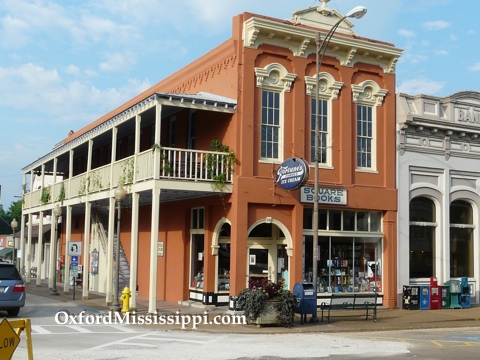
Today the SUVs are part of the view from the balcony of Bouré Restaurant, where students lingering for the summer and gray-haired locals make sure to see and be seen in their pastels and white-against-tan outfits as the sun goes down and jazz begins to be played across the way. Square Books displays John Grisham’s novels proudly alongside Faulkner’s. But what was the Oxford that Faulkner knew? Who were the well-dressed frequenters of restaurants and bars, the churchgoers, the students? Modern-day Oxford offers us a glimpse, but to better understand this creator of Yoknapatawpha County, we must go amongst the trees again.

A little outside the main part of town, majestic cedars line the path leading to Faulkner’s Rowan Oak. There the respectable furnishings, the horse paddock, and the removed tranquility of the grounds reveal him to be a Southern Gentleman—of a most absurdly normal kind. Faulkner did not write about Oxford, Mississippi (AKA the town of Jefferson in Yoknapatawpha County) as an outside observer (at least not entirely). In many ways he was part and parcel of it, raising a family, being an outdoorsman, knowing everyone’s business. And yet his eccentricities show through in the house: on the walls of his study is written the outline of his novel A Fable. MONDAY TUESDAY WEDNESDAY—all the days of a memorable Holy Week in France—organize bullet-pointed occurrences, complete with scratchings-out. It is as if his mind lived in a different element from his immediate surroundings, and yet fed off them and could not create without them and sometimes seeped into them. Even the jittery hipster waiter at the Bottletree Bakery right off the Square sees this man as an odd, odd, fellow, and many a Mississippi grandmother would rather re-read Pride and Prejudice than make sense of As I Lay Dying. But Faulkner kept coming back to this place, physically and mentally, kneading it and baking it until he got a Nobel Prize and a Pulitzer out of it.

He did, of course, leave. Yes, there was Paris, as there was for Hemingway and Fitzgerald and Breton and Dalí and Carpentier. But there was also New Orleans, the city of calliopes played at twilight on the Mississippi—steam organs puffing chipper ragtime and kick-dancing tunes over Jackson Square; the city of nonstop jazz and Spanish guitars on the streets; the city of beignets that make you not care that you’re getting powdered sugar all over your black skirt; the city with a street with a city name that is actually a person’s name commemorating the man who, incidentally, fought the Chickasaw (Bienville); the city where Faulkner spent ten months in an apartment in Pirate’s Alley by the cathedral.

The trees are elsewhere in the Crescent City; they are in the Garden District where houses are dressed up like schoolgirls in their Sunday best. Water, instead, leads to the French Quarter, where our oddball lived. A muddy industrial river and a lake like an ocean hem in the old high ground. The water brings with it another element—the element of alligator and gumbo and shrimps so big they must be prawns. The element of travel, of changeability, of danger.

Certainly the waters of New Orleans stayed with Faulkner as he returned to his Lafayette County, his Yoknapatawpha. Certainly the outside perspective made him see his cedars with their bee hives a little differently. Perhaps it was with watery thoughts that he decided to put a garden of concentric circles in front of his house. But he came back and he stayed.

As a lover of travel and dwelling elsewhere (wherever that happens to be), I find it difficult to understand why a person would keep coming back and back and back to the tiny place where he grew up. But Faulkner understood that Lafayette County contained a whole universe, and he needed to make it his own and people it with the characters of his imagination. To peer into the rooms where he lived and wrote, to leaf through books in the bookstore that was once his apartment in New Orleans, to look up at the clock tower in Oxford Square and imagine Faulkner doing the same—these are ways I have tried to enter this man’s mind a little. By reading his work, I can get to know him. But his eccentric mind will always be a little beyond grasp. Nonetheless, we must keep searching.

I found him somewhere between cedars and crepe myrtles and steamboats. He found himself in Yoknapatawpha, but we could find him anywhere.

Faulkner and I in Oxford, Mississippi.
He is slightly larger than life and looks strikingly like Carlos Fuentes.


Sunday, December 2, 2012

Los Rumberos de Massachusetts

Un, dos, tres, cuatro--

The focus was intense and unbroken. The two guitarists stared into the eyes of the boy with the djembe until they all began cleanly at the same time. The three of them pulled us in but we were shy and we formed a wiggly crescent moon around them, leaving a black bulge of space between us and the raised platform that was the stage. The boy in the middle had left the top three buttons of his shirt undone, the one on the right sported striped purple socks, and on the left the colorful djembe was its own fashion statement. They made music that I normally hear coming out of my laptop speakers as I escape my dorm room to dream of Granada. They played music that wafts around me at dinner when I go home for the holidays. They played music that makes me dance at the best parties that are packed with nobody born here.

In between songs they made Mexican jokes with Mexican accents. Three talented Mexicans serenading us in Cambridge, Massachusetts. They made us carefree while they worked hard.

What does it feel like, I wonder, to have "made it" like that? What does it feel like to sell out concerts when you haven't yet graduated from college? To make people jump up and down with the talent you've honed your whole life, given yourself up to?

They tried to get us to dance. Really dance. Veo muchas chicas bailando acá, y muchos chicos bailando solos allá. A ver cómo le arreglamos. Como dice la canción, "vamos juntando los cuerpos...."

It was invitation. To let ourselves go. To let the strums enter our dreams. To fling the door wide open to let Mexico into a glassed-in Harvard building in Cambridge, Massachusetts.

Wednesday, November 14, 2012

My Language Magazine Article

Lovely Readers,

For today's post I direct you to my article published in this month's issue of Language Magazine, which can be accessed online here.

I hope you enjoy reading about the importance of falling in love with language.

--Alex

Friday, July 13, 2012

María Dueñas

Image from libros.fnac.es
It was fitting that I should be in the middle of reading Ernest Hemingway's For Whom the Bell Tolls when I made my way into the auditorium of the Decatur Library yesterday to hear María Dueñas speak about her debut novel and bestseller, El tiempo entre costuras, or The Time in Between. Having spent three months in Spain recently, I have noticed that Franco's specter still hovers over the country, and even the young people who have no living memories of the dictatorship feel its weight like the bruise left by a claw clamped tight on your shoulder. And it all began in those crucial years of the Spanish Civil War from 1936 to 1939, which Hemingway tells of so vividly in For Whom the Bell Tolls. You can learn history from the history books, but where will you learn of how the fascists were killed, one by one, in a small peasant town? Or of the illiterate wisdom of the horse trainers who made a revolution? Or of the soldier's urgency to make love before his probable death? This sort of thing you learn of in a novel, guided by the hand of a peerless storyteller such as Hemingway.

El tiempo entre costuras begins just before the eruption of the civil war and continues into World War II, following a young seamstress as she learns the ways of the world and sheds her naïvité, sewing herself deelpy into the canvas of her society. The novel bridges Spain and Morocco, lower-class humility and upper-class power. María Dueñas spoke romantically of the pre-independence Morocco that the older members of her family still remember vividly. She spoke of her creative process, making it clear that she had deemed this project a necessary step in the consolidation of her family's stories and the stories of a whole generation, which would otherwise be lost. A professor of English language and literature at the University of Murcia, she was trained as an academic and applied these same research methods to her book, consulting histories, memoirs, and old newspapers, in addition to the oral histories of her family. She was a living illustration of the ultimate compatibility of academia and creativity; the divide between the two, which separates scholarly analysis from the creation of fiction and often elevates one above the other within the ivory towers, can be dispelled like a smokescreen, if only we have a little courage.

She was also a living illustration of a successful female author. As a woman, I am grateful to her as a role model. To Isabel Allende also I am grateful. Hemingway told us how Robert Jordan's heart beat against the snow that melted and wet his shirt beneath him as he lay watching Fascist cavalry through the sight of a machine gun. Now Dueñas can tell us how at the same time Sira trudged with the weight of pistols strapped to her body under a burka to smuggle them to a man in a bathroom stall of the train station in Tetuan, Morocco. There are many stories about men, and in the still-patriarchal society of Spain, I am glad that a woman is telling a woman's story.

Dueñas pointed out that Spain and the U.S. have long had a curious and sometimes intimate relationship. She herself as well as Hemingway are examples of this. Her next novel, Misión Olvido, deals directly with this intercontinental relationship. We should pay more attention to what connects us. As one who straddles the two continents out of a visceral necessity to do so, I am more than content that the Georgia Center for the Book has brought an author from Murcia, Spain all the way to Decatur, Georgia.

The following is an image of my mother's 1982 edition of For Whom the Bell Tolls, which she bought in Salamanca, Spain, and which I am currently reading. I love the yellowing paper that is both soft and coarse like the pages of King Arthur and His Kinghts, Little Women, and Treasure Island that I also read as a child from my mother's library of those books that escaped the fire to her Charlottesville apartment years ago. I love especially the pages in the middle where the spine has cracked--the ones that want to turn themselves loose from the brittle glue like golden autumn leaves and that I must hold in place very gingerly as one holds a sleeping baby's head.


Image from bookstation.hu